Mbed Blog
ARM University Program to run mbed workshops
 Chris Styles.
0
replies
Chris Styles.
0
replies
On June 17th the ARM University Program will be running a one-day Microcontroller Workshop at ARM Headquarters in Cambridge.
These workshops are exclusively for teaching faculty and post-graduate members of academia, and will provide the knowledge needed to teach students to use these tools in Labs and Projects.
The objective of this workshop is simple: “train the trainer”, so you are able to share this knowledge with your students.

ARM mbed + Xively = Internet connected products, fast!
Chris Styles.
4
replies
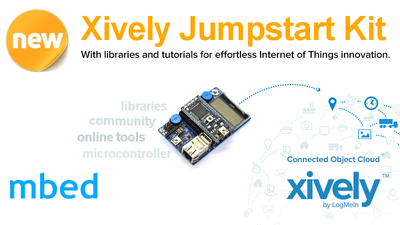
We’re excited to announce we’re partnering with Xively on a kit for developers creating Internet of Things products! Xively builds on COSM/Pachube technology which leverages LogMeIn’s cloud that already connects over 250 million devices worldwide (mbed users among them). Combined with mbed you can rapidly prototype connected devices and co-develop IoT solutions, then easily migrate to a production design.
Issue Tracker now available for all code repositories
We are pleased to announce the introduction of an issue tracker for every mbed code repository (libraries and programs).

CMSIS Components used by mbed are now BSD Licensed
We are pleased to announce that the CMSIS software components used by the mbed SDK have been released under a permissive BSD open source license!

mbed fest 2013 WEST
 Stephen Paulger.
1 reply
Stephen Paulger.
1 reply
mbed fest 2013 WEST was held on April 13th 2013 in Osaka.  NXP fan (in Japan) has sent us this report of the event.
Prototype the Internet of Things (Free hardware up for grabs!)
Chris Styles.
7
replies
Following our announcement that mbed.org now supports the Freescale FRDM KL25Z, I got a call from Jim Carver at Avnet, who was keen to tell me about their new Wi-Go module for the the FRDM KL25Z, which has been designed for prototyping "Internet of Things" applications.
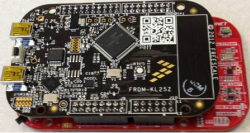
The module has a sensor for just about everything you might want to sense :
- 3 Axis accelerometer for 3D acceleration (MMA8451Q)
- Magnetometer for compass direction (MAG3110)
- Altimeter based elevation (MPL3115A2)
- Air Pressure (MPL3115A2)
- Temperature (MPL3115A2)
- Ambient Light Level (TEMT6200)
- Serial flash memory (S25FL216K)
- Wi-Fi Communications module (LBWA1ZZVK7)
It also includes an 800mAH LiPo battery, which is capable of powering the module for a substantial length of time, and can also be recharged from USB connector. This makes it great for prototyping untethered nodes for IoT Applications.
Debugging from GDB using pyOCD!
We are pleased to release a python library which allows to drive the Debug Access Port of Cortex-M microcontrollers over CMSIS-DAP!
What can be achieved with pyOCD?
- Debugging using GDB, as a gdbserver is integrated on the library
- Writing python applications that can communicate with the CMSIS-DAP and coresight debug interface:
- read/write memory
- read/write core registers
- set breakpoints
- flash new binary
- run/stop/step the execution
- Act as a great reference to show how the CMSIS-DAP protocol works
Currently, the library works on Windows (using pyWinUSB as backend) and on Linux (using pyUSB as backend).
Full debugging interface on mbed-enabled platforms!
We are pleased to announce we have added CMSIS-DAP support to the mbed HDK firmware for the following targets:
- mbed NXP LPC1768
- mbed NXP LPC11U24
- FRDM-KL25Z
The new firmware upgrade, in addition to a drag n drop flash programming and a virtual serial port interface, provide a CMSIS-DAP interface in order to fully debug your platform for tools that support the CMSIS-DAP protocol.
This, combined with the exporting to toolchain features, means if and when you transition to a full debug toolchain as part of productisation, you don't need to change your hardware to:
- set breakpoints to stop the program at some event or at a specified instruction to examine the current state
- step by step execute a program to track the control flow
- check variables values
- inspect and modify memory contents
You can now upgrade your board very easily to support full CMSIS-DAP debug. Just select your board and follow the instructions:
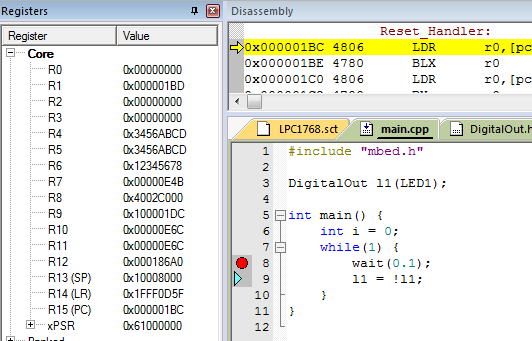
Whilst the Online IDE doesn't support a debugger, here is an example of using this new feature with uVision MDK:
In this post, I would like to explain in more detail how CMSIS-DAP works.
mbed Application Board on sale!
Chris Styles.
14
replies
You need to log in to post a reply