You are viewing an older revision! See the latest version
CAN
CAN or Controller-area Network is a bus standard designed to allow microcontrollers and devices to communicate with each other without a host computer.
Hello World!
Loopback example
#include "mbed.h"

Ticker ticker;
DigitalOut led1(LED1);
DigitalOut led2(LED2);
CAN can1(p9, p10);
CAN can2(p30, p29);
char counter = 0;

void send() {
    printf("send()\n");
    if(can1.write(CANMessage(1337, &counter, 1))) {
        printf("wloop()\n");
        counter++;
        printf("Message sent: %d\n", counter);
    }
    led1 = !led1;
}

int main() {
    printf("main()\n");
    ticker.attach(&send, 1);
    CANMessage msg;
    while(1) {
        printf("loop()\n");
        if(can2.read(msg)) {
            printf("Message received: %d\n", msg.data[0]);
            led2 = !led2;
        }
        wait(0.2);
    }
}
This example sends from one CAN bus (can1) an counter while it is listen on the other CAN bus (can2) to receive a packet. Each bus controller should be connected to a CAN bus transceiver. These should be connected together at a CAN bus.
API
API summary
Import librarymbed
No documentation found.
Details
The CAN Interface can be used on mbed pins p9/p10 and p30/p29
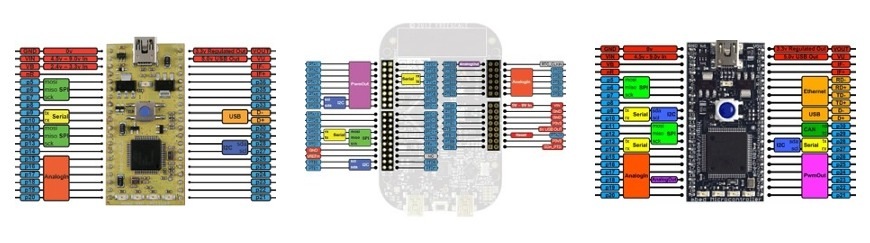 |
| See the Pinout page for more details |
The CAN Interface can be used to write data words out of a CAN port and will return the data received from another CAN device. The CAN clock frequency can be configured.