no problem, you can use ohms law here:
This is the complex but most accurate way:
If you send a fixed current through a resistor the voltage over the resistor will be proportional to the resistance.
So if you send 10 mA through a resistor of 300 ohm you will measure a voltage of 0.01 * 300 = 3 Volts
With a resistor of 200 ohms it will be 2 Volts etc. etc.
All you need is a constant current source.. :-) http://en.wikipedia.org/wiki/Current_source
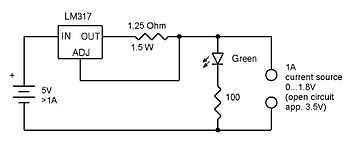
You can make one of a low voltage stabilizer IC, connect a good quality (1%) resistor between the output and the common or adj. pin and put it in series with a power supply. Something like this:
Replace the 1.25 ohm resistor for a 120 ohm (or even better: a 125 ohm) and the current will be a constant 0.01A
The resistor you want to read out is connected to the output and ground, the voltage can then be measured with the mbed.
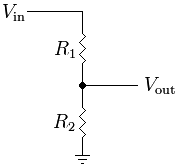
A simpler solution is to connect a known resistor to the +3.3 Volt output of the mbed module and connect your unknown resistor in series to ground. The junction in between is connected to an analog input of the mbed. But then you need to create a table or calculation for the resistance to voltage ratio.
http://en.wikipedia.org/wiki/Voltage_divider
Hello,
Hardware:
0 to 10K Poti
1 LED
I want to write one program that at a voltage above 2V LED getting on. Is it higher 3V, the LED agetting off.
How i get it?