ECE 4180 Lab 3
Page last updated 07 Mar 2013, by  YongChing Tee.
0
replies
YongChing Tee.
0
replies
YongChing Tee.
0
replies
Audio Player using RPG, TextLCD, and SD card
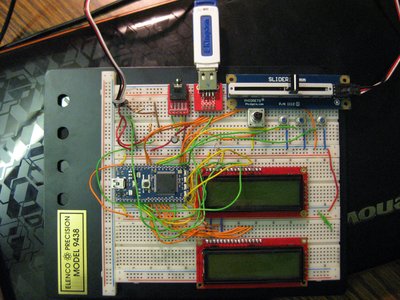
- Implemented a fully functional audio player that plays .wav files from a USB drive.
Schematic
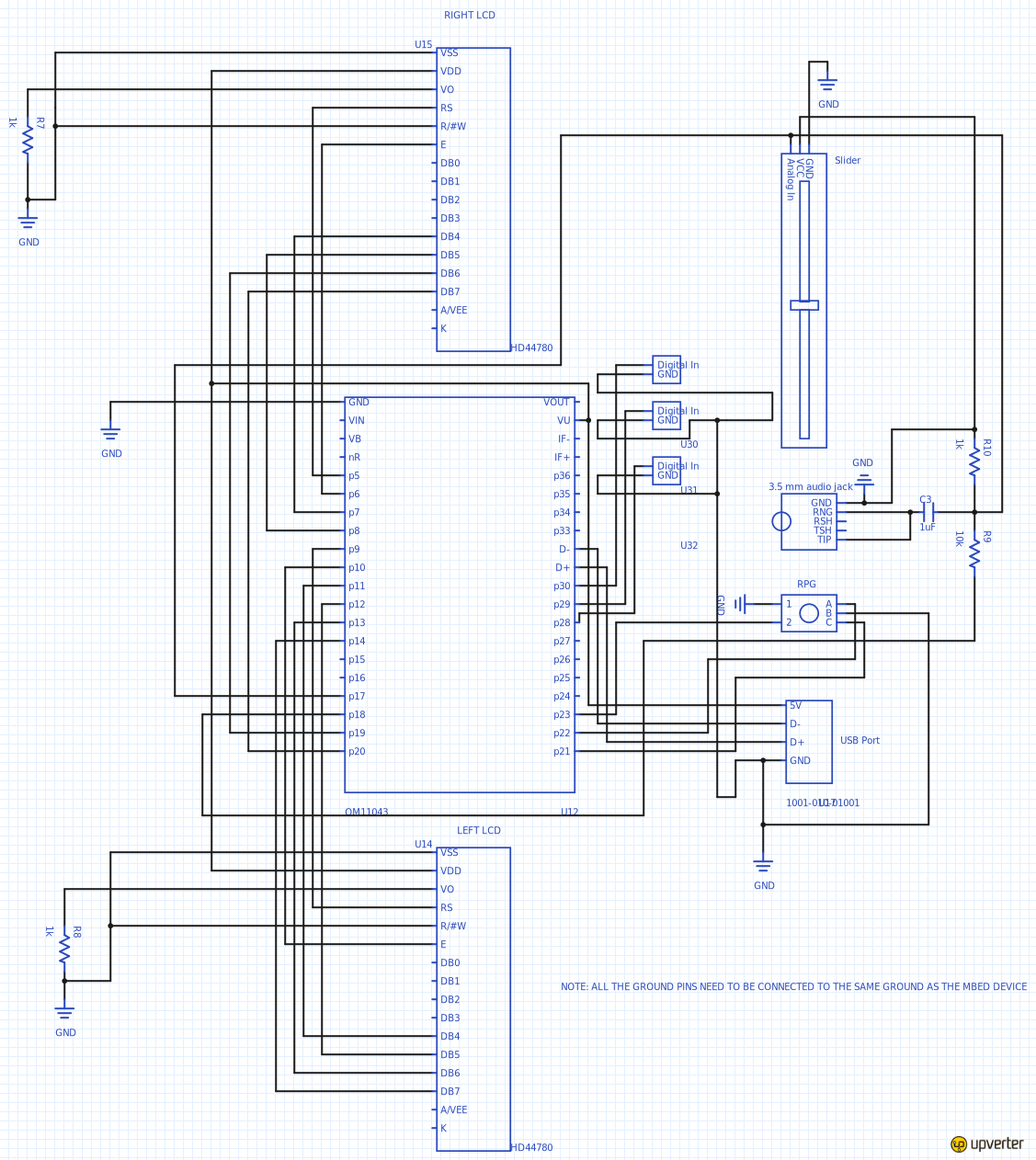
Functions
Audio Player
- Plays .wav files from a USB drive.
- Using a USB socket and the MSCFileSystem library originally obtained from http://mbed.org/users/chris/code/MSCUsbHost_FULL/docs/tip/files.html
Song List
- The list of songs that are in the USB are displayed on LCD 1.
Main Menu
- A main menu consisting of the volume and the state of the audio player is displayed on LCD 1.
Controls
- The song can be played, paused and stopped using three push buttons.
Volume Control
- The volume of the audio output can be controlled by using a slider.
Song Choice
- The list of songs available can be scrolled through using an RPG and the current song is displayed on LCD 2.
Audio Output
- The audio is outputted from an audio jack.
- Therefore the audio can be played through earphones or speakers.
Playlist
- The user can save a playlist of songs that will be played continuously.
- A song can be added to the playlist by pressing the stop button in the STOP state.
Demo Video
Code
main.cpp
- main code used to implement an audio player
main.cpp
#include "mbed.h"
#include "RPG.h"
#include "TextLCD.h"
#include "wave_player.h"
#include "MSCFileSystem.h"
#include <string.h>
#include <cstdio>

#define FSNAME "msc"
MSCFileSystem msc(FSNAME);

RPG rpg1(p21,p22,p23); //Set up RPG
TextLCD lcd1(p9, p10, p11, p12, p13, p14, TextLCD::LCD20x4); // rs, e, d4-d7
TextLCD lcd2(p5, p6, p7, p8, p19, p20, TextLCD::LCD20x4);
AnalogOut mySpeaker(p18);
DigitalIn pb_add(p29);
//SDFileSystem sd(p5, p6, p7, p8, "sd"); // the pinout on the mbed Cool Components workshop board
AnalogIn position(p17); //slider
wave_player waver(&mySpeaker);
Serial term(USBTX, USBRX); // tx, rx
int volume = 0;

int count = 0;
int dirt = 0;
char* songList[50];
char* playList[10];
int index = 0;
int index_play = 0;
int len;
int main()
{

    DIR *d;
    struct dirent *p;
    d = opendir("/" FSNAME);

    if ( d != NULL )
    {
        while ( (p = readdir(d)) != NULL )
        {
            songList[index] = (char*)malloc(sizeof(char) * strlen(p->d_name));
            term.printf(" - %s\n", p->d_name);
            strcpy(songList[index++], p->d_name);
        }
        songList[index] = (char*)malloc(sizeof(char) * 8);
        strcpy(songList[index++], "Playlist");
    }
    else
    {
        error("Could not open directory!");
    }

    pb_add.mode(PullUp);
    FILE *wave_file;

    while(1)
    {
        char * selectedFile;
        volume = position*300;
        dirt = rpg1.dir(); //Get Dir
        count = count + dirt; //Ad Dir to count
        if(count > (index-1)){
            count = 0;
        }
        if(count < 0){
            count = index-1;
        }

        lcd1.cls();
        lcd1.printf("Song List: \n"); //Print out Count
        lcd1.printf("%s ", songList[count]);

        lcd2.cls();
        lcd2.printf("Volume: %d \n", volume); //Print out Count
        lcd2.printf("Mode: STOP");

        if(!pb_add)
        {
            playList[index_play] = (char*)malloc(sizeof(char) * strlen(songList[count]));
            strcpy(playList[index_play++], songList[count]);
            lcd2.cls();
            lcd2.printf("Song Added to PlayList"); //Print out Count
            wait(0.5);
        }
        if (rpg1.pb())
        {
           if(count == (index-1)&&index_play > 0)
           {
                for(int i = 0; i < (index_play);i++)
                {
                    len = 5+strlen(playList[i]);
                    selectedFile = (char*)malloc(sizeof(char) * len);
                    strcpy(selectedFile, "/msc/");
                    strcat(selectedFile, playList[i]);
                    wave_file=fopen(selectedFile,"r");
                    lcd2.cls();
                   lcd2.printf("Volume: %d \n", volume); //Print out Count
                   lcd2.printf("Mode: PLAY");
                   waver.play(wave_file);
                   fclose(wave_file);
                   free(selectedFile);
                   if(!pb_add) //stop the whole play list
                        break;
                }
           }
           else
           {
               len = 5+strlen(songList[count]);
               selectedFile = (char*)malloc(sizeof(char) * len);
               strcpy(selectedFile, "/msc/");
               strcat(selectedFile, songList[count]);
               wave_file=fopen(selectedFile,"r");
               lcd2.cls();
               lcd2.printf("Volume: %d \n", volume); //Print out Count
               lcd2.printf("Mode: PLAY");
               waver.play(wave_file);
               fclose(wave_file);
               free(selectedFile);
           }
           while(!pb_add){}; //prevent from adding stuff to the play list
        }
    }

}
wave_player.cpp
- edited version of wave_player.cpp, originally obtained from http://mbed.org/users/sravet/code/wave_player/
wave_player.cpp
//-----------------------------------------------------------------------------
// a sample mbed library to play back wave files.
//
// explanation of wave file format.
// https://ccrma.stanford.edu/courses/422/projects/WaveFormat/

// if VERBOSE is uncommented then the wave player will enter a verbose
// mode that displays all data values as it reads them from the file
// and writes them to the DAC.  Very slow and unusable output on the DAC,
// but useful for debugging wave files that don't work.
//#define VERBOSE


#include <mbed.h>
#include <stdio.h>
#include <wave_player.h>
#include "TextLCD.h"

Serial pc(USBTX, USBRX);
DigitalIn pb_pause(p30);
DigitalIn pb_stop(p29);
DigitalIn pb_play(p28);
TextLCD lcd_player(p5, p6, p7, p8, p19, p20, TextLCD::LCD20x4);
AnalogIn position_player(p17); //slider
//-----------------------------------------------------------------------------
// constructor -- accepts an mbed pin to use for AnalogOut.  Only p18 will work
wave_player::wave_player(AnalogOut *_dac)
{
  wave_DAC=_dac;
  wave_DAC->write_u16(32768);        //DAC is 0-3.3V, so idles at ~1.6V
  verbosity=0;
}

//-----------------------------------------------------------------------------
// if verbosity is set then wave player enters a mode where the wave file
// is decoded and displayed to the screen, including sample values put into
// the DAC FIFO, and values read out of the DAC FIFO by the ISR.  The DAC output
// itself is so slow as to be unusable, but this might be handy for debugging
// wave files that don't play
//-----------------------------------------------------------------------------
void wave_player::set_verbosity(int v)
{
  verbosity=v;
}

//-----------------------------------------------------------------------------
// player function.  Takes a pointer to an opened wave file.  The file needs
// to be stored in a filesystem with enough bandwidth to feed the wave data.
// LocalFileSystem isn't, but the SDcard is, at least for 22kHz files.  The
// SDcard filesystem can be hotrodded by increasing the SPI frequency it uses
// internally.
//-----------------------------------------------------------------------------
void wave_player::play(FILE *wavefile)
{
        unsigned chunk_id,chunk_size,channel;
        unsigned data,samp_int,i;
        short unsigned dac_data;
        long long slice_value;
        char *slice_buf;
        short *data_sptr;
        unsigned char *data_bptr;
        int *data_wptr;
        FMT_STRUCT wav_format;
        long slice,num_slices;
        pb_pause.mode(PullUp);
        pb_stop.mode(PullUp);
        pb_play.mode(PullUp);
        int volume_player = 0;
        int count = 0;
  DAC_wptr=0;
  DAC_rptr=0;
  for (i=0;i<256;i+=2) {
    DAC_fifo[i]=0;
    DAC_fifo[i+1]=3000;
  }
  DAC_wptr=4;
  DAC_on=0;

  fread(&chunk_id,4,1,wavefile);
  fread(&chunk_size,4,1,wavefile);
  while (!feof(wavefile)) {
    if (verbosity)
      pc.printf("Read chunk ID 0x%x, size 0x%x\n",chunk_id,chunk_size);
    switch (chunk_id) {
      case 0x46464952:
        fread(&data,4,1,wavefile);
        if (verbosity) {
          pc.printf("RIFF chunk\n");
          pc.printf("  chunk size %d (0x%x)\n",chunk_size,chunk_size);
          pc.printf("  RIFF type 0x%x\n",data);
        }
        pc.printf("case1\n");
        break;
      case 0x20746d66:
        fread(&wav_format,sizeof(wav_format),1,wavefile);
        if (verbosity) {
          pc.printf("FORMAT chunk\n");
          pc.printf("  chunk size %d (0x%x)\n",chunk_size,chunk_size);
          pc.printf("  compression code %d\n",wav_format.comp_code);
          pc.printf("  %d channels\n",wav_format.num_channels);
          pc.printf("  %d samples/sec\n",wav_format.sample_rate);
          pc.printf("  %d bytes/sec\n",wav_format.avg_Bps);
          pc.printf("  block align %d\n",wav_format.block_align);
          pc.printf("  %d bits per sample\n",wav_format.sig_bps);
        }
        if (chunk_size > sizeof(wav_format))
          fseek(wavefile,chunk_size-sizeof(wav_format),SEEK_CUR);
         pc.printf("case2\n");
        break;
      case 0x61746164:
// allocate a buffer big enough to hold a slice
        slice_buf=(char *)malloc(wav_format.block_align);
        if (!slice_buf) {
          pc.printf("Unable to malloc slice buffer");
          exit(1);
        }
        num_slices=chunk_size/wav_format.block_align;
        samp_int=1000000/(wav_format.sample_rate);
        if (verbosity) {
          pc.printf("DATA chunk\n");
          pc.printf("  chunk size %d (0x%x)\n",chunk_size,chunk_size);
          pc.printf("  %d slices\n",num_slices);
          pc.printf("  Ideal sample interval=%d\n",(unsigned)(1000000.0/wav_format.sample_rate));
          pc.printf("  programmed interrupt tick interval=%d\n",samp_int);
        }

// starting up ticker to write samples out -- no printfs until tick.detach is called
        if (verbosity)
          tick.attach_us(this,&wave_player::dac_out, 500000);
        else
          tick.attach_us(this,&wave_player::dac_out, samp_int);
        DAC_on=1;

// start reading slices, which contain one sample each for however many channels
// are in the wave file.  one channel=mono, two channels=stereo, etc.  Since
// mbed only has a single AnalogOut, all of the channels present are averaged
// to produce a single sample value.  This summing and averaging happens in
// a variable of type signed long long, to make sure that the data doesn't
// overflow regardless of sample size (8 bits, 16 bits, 32 bits).
//
// note that from what I can find that 8 bit wave files use unsigned data,
// while 16 and 32 bit wave files use signed data
//
        for (slice=0;slice<num_slices;slice+=1) {
          fread(slice_buf,wav_format.block_align,1,wavefile);
          if (feof(wavefile)) {
            pc.printf("Oops -- not enough slices in the wave file\n");
            exit(1);
          }
          data_sptr=(short *)slice_buf;     // 16 bit samples
          data_bptr=(unsigned char *)slice_buf;     // 8 bit samples
          data_wptr=(int *)slice_buf;     // 32 bit samples
          slice_value=0;
          for (channel=0;channel<wav_format.num_channels;channel++) {

            switch (wav_format.sig_bps) {
              case 16:
                if (verbosity)
                  pc.printf("16 bit channel %d data=%d ",channel,data_sptr[channel]);
                slice_value+=data_sptr[channel];
                break;
              case 32:
                if (verbosity)
                  pc.printf("32 bit channel %d data=%d ",channel,data_wptr[channel]);
                slice_value+=data_wptr[channel];
                break;
              case 8:
                if (verbosity)
                  pc.printf("8 bit channel %d data=%d ",channel,(int)data_bptr[channel]);
                slice_value+=data_bptr[channel];
                break;
            }
          }
          slice_value/=wav_format.num_channels;

// slice_value is now averaged.  Next it needs to be scaled to an unsigned 16 bit value
// with DC offset so it can be written to the DAC.
          switch (wav_format.sig_bps) {
            case 8:     slice_value<<=8;
                        break;
            case 16:    slice_value+=32768;
                        break;
            case 32:    slice_value>>=16;
                        slice_value+=32768;
                        break;
          }
          dac_data=(short unsigned)slice_value;
          if (verbosity)
            pc.printf("sample %d wptr %d slice_value %d dac_data %u\n",slice,DAC_wptr,(int)slice_value,dac_data);
          DAC_fifo[DAC_wptr]=dac_data;
          //controls
          count++;

          if(count%10000 == 0)
          {
            volume_player = position_player*300;
            lcd_player.cls();
            lcd_player.printf("Volume: %d \n", volume_player); //Print out Count
            lcd_player.printf("Mode: PLAY");
          }
          if(!pb_pause)
          {
                tick.detach();
                lcd_player.cls();
                lcd_player.printf("Volume: %d \n", volume_player); //Print out Count
                lcd_player.printf("Mode: PAUSE");

                while(1)
                {
                    count++;
                    if(count%1000000 == 0)
                      {
                        volume_player = position_player*300;
                        lcd_player.cls();
                        lcd_player.printf("Volume: %d \n", volume_player); //Print out Count
                        lcd_player.printf("Mode: PAUSE");
                      }
                    //lcd_player.printf("Volume: %d \n", volume_player); //Print out Count
                    if(!pb_play)
                    {
                        tick.attach_us(this,&wave_player::dac_out, samp_int);
                        lcd_player.cls();
                        lcd_player.printf("Volume: %d \n", volume_player); //Print out Count
                        lcd_player.printf("Mode: PLAY");
                        break;
                    }
                }
          }
          if(!pb_stop)
          {
                tick.detach();
                //while(!pb_stop){};//prevent from adding to playlist
                return;
          }
          //controls end
          DAC_wptr=(DAC_wptr+1) & 0xff;
          while (DAC_wptr==DAC_rptr) {
          }
        }
        DAC_on=0;
        tick.detach();
        free(slice_buf);
         pc.printf("case3\n");
        break;
      case 0x5453494c:
        if (verbosity)
          pc.printf("INFO chunk, size %d\n",chunk_size);
        fseek(wavefile,chunk_size,SEEK_CUR);
         pc.printf("case4\n");
        break;
      default:
        pc.printf("unknown chunk type 0x%x, size %d\n",chunk_id,chunk_size);
        data=fseek(wavefile,chunk_size,SEEK_CUR);
        break;
    }
    fread(&chunk_id,4,1,wavefile);
    fread(&chunk_size,4,1,wavefile);
  }
}


void wave_player::dac_out()
{
  if (DAC_on) {
#ifdef VERBOSE
  pc.printf("ISR rdptr %d got %u\n",DAC_rptr,DAC_fifo[DAC_rptr]);
#endif
    wave_DAC->write_u16(DAC_fifo[DAC_rptr]);
    DAC_rptr=(DAC_rptr+1) & 0xff;
  }
}
Full Program
References
- http://mbed.org/cookbook/Text-LCD
- http://mbed.org/users/4180_1/notebook/using-a-speaker-for-audio-output/
- http://mbed.org/users/canderson199/notebook/rotary-pulse-generator-library/
- http://www.pavius.net/2010/02/rotary-encoder-based-cooking-timer/
- http://mbed.org/handbook/AnalogIn
- http://mbed.org/handbook/USBDevice
- http://upverter.com/
Please log in to post comments.