You are viewing an older revision! See the latest version
Lab 6
Chapter 6: Sustainability and Renewable Energy
Introduction
The Sustainability and Renewable Energy field addresses global technological challenges balancing societal needs with environmental and economic trade-offs. Topics addressed include energy conservation through more efficient electronic systems, intelligent energy management through smart grid approaches, and renewable technologies including solar, wind, and wave for energy generation and distribution. Students pursuing the Sustainability and Renewable Energy are of interest will engage in leadership development and demonstrate their leadership through community service related to sustainability. It is recommended that the leadership service take place as part of an international experience.
Section Overview
A number of activities have been done in lab that deal with the various electrical and computer engineering tracks here at OSU. However, many problems you'll deal with in the future will involve multiple electrical engineering disciplines. This lab involves using photovoltaic cells (sometimes known as solar cells), which encompasses two of the areas of interest that were covered before: Materials and Devices and Energy Systems. Ideas from these two areas are combined to use a green form of energy and relate to the new Sustainability and Renewable Energy area pf interest.
The completion of this project will result in a solar cell positioning system. The Mbed will rotate a motor with a solar cell attached to it. The voltage of the solar cell will be read using the ADC (Analog-to-Digital Converter) in the Mbed, and storing that data. Then, the motor will rotate back to the point where the voltage from the solar cell was highest (where it is converting the most energy).
Objectives
- Solar Energy and the integration into electronics.
- Analyze efficiency tradeoffs.
Materials
- Mbed KL46-z.
- USB to mini cable.
- ECE 111 Kit.
- Photovoltaic cell.
- Rectangular piece of protoboard with single drill hole.
- L Bracket motor adapter.
How Light is Affected by the Angle
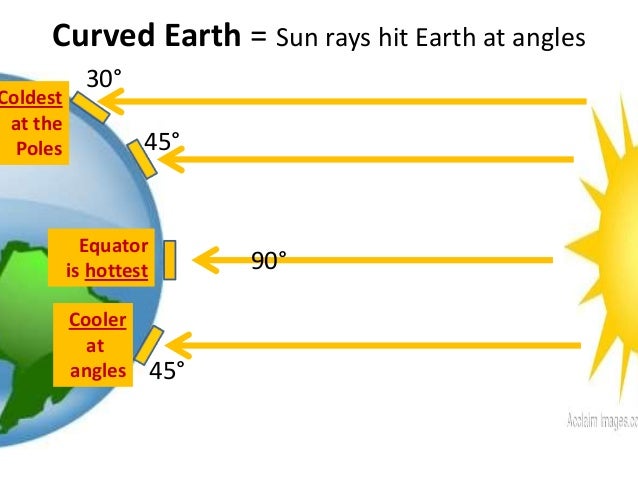
The amount of light and heat energy received at a point on the globe is directly affected by the angle the sun's rays strike the earth. This angle is affected by location, time of day, and season because the Earth is constantly orbiting around the sun and revolving upon its tilted axis. As shown in Figure , the reason that the poles are colder and have greater fluctuating day lengths than the rest of the earth is because the sunlight is spread over a greater area in those regions, and because the light also has to go through twice as much atmosphere, further dissipating the rays and reflecting more of the energy back into space.
Photovoltaic Cells
A photovoltaic (PV) cell is a device that converts light directly into electricity. Many photovoltaic cells are made of silcon, which is a type of semiconductor. The energy from the light knocks electrons loose, allowing them to flow freely. This flow of electrons is a current, and by placing metal contacts on the top and bottom of the PV cell, we can draw that current off to use externally. For example, the current can power a calculator. Understanding PV cells is important, because alternative energy is a rapidly expanding field of engineering.
Modeling Concepts
The concept of the sun's rays hitting the earth at different angles can be simplified and modeled in lab using a photovoltaic cell and directed light source as shown below in Figure , and mathematics can support it. This is important, because while everything must start as a concept, for it to be accepted and proven, engineers rely heavily upon mathematics and physics to support their ideas.
Mathematical Support
Shadow width = Solar Cell Width \times cos(\theta)$ \end{center} Basic trigonometry shows us that the cosine of a 60$^o$ angle is 0.5, whereas the cosine of 90$^o$ is 0. Therefore, with a lamp beam of approximately 4 inch width directly hitting a 4 inch wide PV cell as shown in Figure \ref{single1}, there will be maximum voltage output, because the most light is hitting it. The PV cell is at a 0$^o$ angle with the ground, and therefore the cosine is 1. In Figure \ref{double1}, the PV cell is at a 60$^o$ angle with the ground, and therefore the cosine is 0.5, meaning that only half the amount of light is hitting the PV cell, and therefore the voltage output will be less as well.
\subsection{Experimental Support} Now that there is mathematical support of the concept, there needs to be observational support as well through experimentation. A protractor is helpful but not required. Measure the voltages produced by the PV cell at no less than 7 different points between 0$^o$ and 90$^o$. 0$^o$ being what is shown in Figure \ref{single1}. Graph these points on Figure \ref{voltagevsdegrees} and analyze the resulting line. \centerimage{\includegraphics[scale=.6]{Images/voltagevsdegrees}}{Voltage Output vs. Degrees}{voltagevsdegrees} \begin{description} \item \textbf{Distance between Lamp and PV Cell (at 0$^o$)$:$} \rule{2in}{.5pt} \end{description}